
- February 19, 2026
- By Salim
Insulation R-Value Chart: A Simple Guide for Homeowners
Does your home feel less like a cozy retreat and more like a source of stress? When you see that monthly energy bill, or feel a stubborn draft that just won’t go away, it’s easy to feel overwhelmed. You know insulation is the answer, but then you hear technical terms like “R-value,” and the whole process can feel confusing. You just want your family to be comfortable without worrying if you’re making the right choice.
We believe every homeowner deserves peace of mind. That’s why we created this simple guide to the insulation R-value chart. We’re here to translate the technical jargon into clear, honest advice so you can feel confident about protecting your home. Think of this as your friendly roadmap to lower energy bills and year-round comfort.
In this article, we’ll walk you through exactly what R-value means and help you find the perfect level of insulation for your attic, walls, and floors. Our goal is to empower you with the knowledge you need to turn your house back into the warm, welcoming sanctuary it was always meant to be.
Key Takeaways
- Discover what R-value means for your home’s comfort in simple, easy-to-understand terms.
- Find the recommended R-values for your attic and walls using the official insulation r value chart for Central Pennsylvania.
- Learn how to perform a quick, safe check of your own attic insulation to see where your home stands today.
- Uncover the other critical factors beyond R-value that contribute to a truly cozy and energy-efficient home.
What is R-Value? A Friendly Explanation for Your Cozy Home
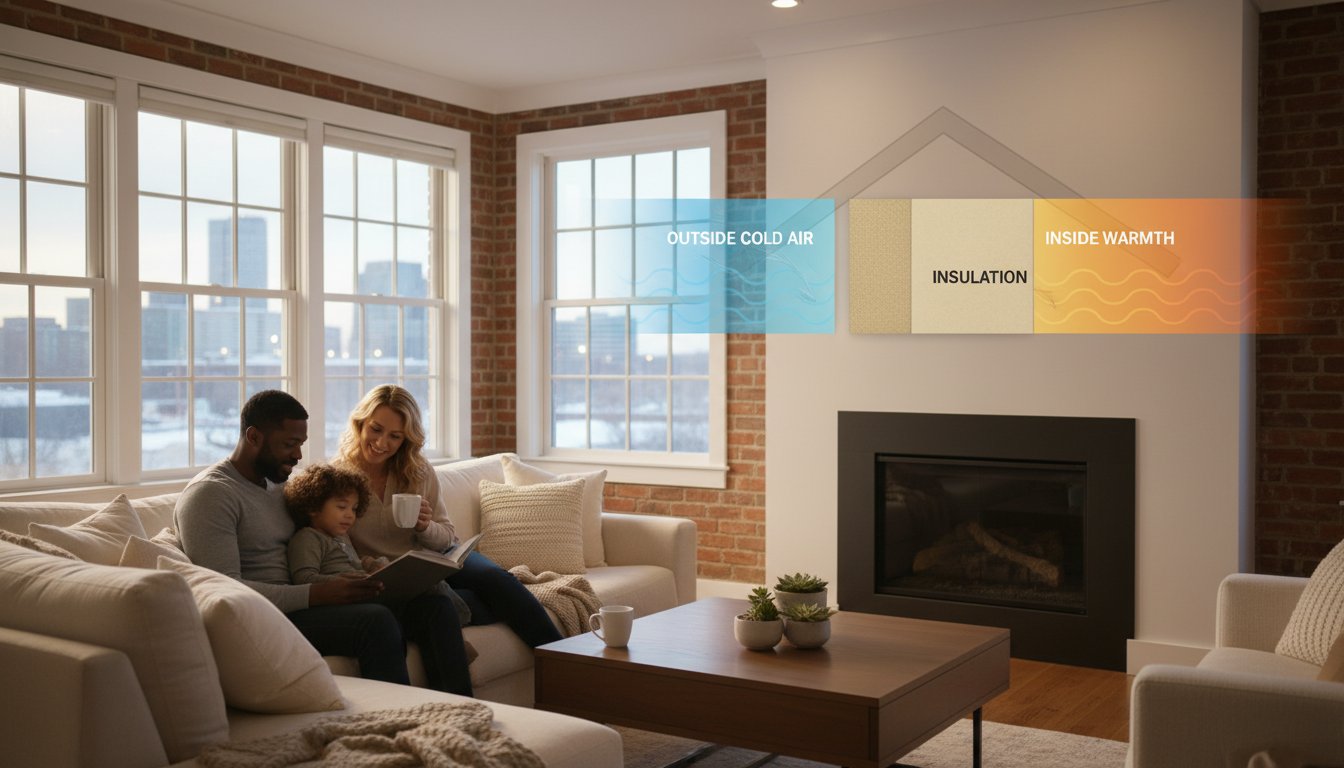
Think of R-value like the TOG rating on your favorite duvet-a higher number means it’s warmer and cozier for a good night’s sleep. In the world of home comfort, R-value is a simple grade that tells you how well insulation can resist the flow of heat. The technical answer to What is R-Value? involves some complex science, but for homeowners, the rule is wonderfully simple: a higher R-value means better insulating performance and more year-round peace of mind.
Heat naturally moves from warmer areas to cooler ones. In the winter, it tries to escape your toasty living room and flee into the cold air outside. In the summer, the sweltering heat tries to invade your cool, air-conditioned space. The right R-value acts like a protective shield, slowing this heat transfer down significantly. This keeps your home warmer in the winter and cooler in the summer, which means your furnace and AC don’t have to work so hard. Finding the perfect level of protection often starts with a professional look at an insulation r value chart for our specific climate zone.
Why ‘Higher’ Isn’t Always the Only Answer
While a higher number is generally better, chasing the absolute highest R-value isn’t always the most practical goal. There’s a point of diminishing returns where doubling the insulation doesn’t double your energy savings. We also consider your budget and the physical space available in your walls or attic. Our honest advice is always focused on finding the right R-value that gives your family the best comfort and financial return for your investment.
R-Value vs. U-Factor: What’s the Difference?
You might see “U-Factor” mentioned when shopping for windows or doors. Think of it as the opposite of R-value. While R-value measures heat Resistance (where higher is better), U-Factor measures how much heat flows through a material (where lower is better). They are simply two sides of the same coin. For your home’s attic, crawl space, and wall insulation, R-value is the key number to focus on for creating that truly cozy, protected feeling.
The Official R-Value Chart: What Your Home Needs in Pennsylvania
Choosing the right insulation isn’t a one-size-fits-all solution. A home in sunny Florida has very different needs than one here in Pennsylvania, where we enjoy all four seasons. To help homeowners get it right, the U.S. Department of Energy created a climate zone map that breaks the country into regions with similar weather patterns.
As you can see, Central Pennsylvania falls squarely into Climate Zone 5. This means we need robust insulation to stay cozy during our chilly winters and comfortable during our humid summers. Understanding our zone is the first step toward creating a peaceful, energy-efficient home for your family.
[Image: U.S. Department of Energy Climate Zone Map, with Pennsylvania and Zone 5 clearly highlighted.]
Recommended R-Values for Zone 5 (Central PA)
So, what does being in Zone 5 mean for your home? Below is a simple insulation r value chart with the recommended R-values to give your family the protection and peace of mind they deserve. These are the targets we aim for to maximize your comfort and savings.
| Area of Your Home | Recommended R-Value (Zone 5) |
|---|---|
| Attic (uninsulated) | R49 to R60 |
| Walls (2×4 Construction) | R13 to R15 |
| Floors & Crawl Spaces | R25 to R30 |
Why Different Parts of Your House Need Different R-Values
Think of your home’s insulation like a warm winter coat-you need more protection in some areas than others. Since heat naturally rises, your attic is the most critical area for preventing heat from escaping in the winter. That’s why it requires the highest R-value. Walls lose heat differently, while poorly insulated floors and crawl spaces are often the source of those chilly drafts that make a home feel uncomfortable. Selecting the right R-value for each area ensures consistent comfort from floor to ceiling. The U.S. Department of Energy provides a helpful guide to Common Insulation Materials that work best in these different spaces.
What if You Live in a Different Climate Zone?
While our focus is always on our neighbors here in Central PA, we know you may have family in other parts of the country. As you move north into colder zones like 6 or 7, the recommended R-values increase to provide even greater protection. For a complete list, you can view the full chart on the Energy Star website. But for local homeowners, sticking to the Zone 5 guidelines is the surest path to a cozy, cost-effective home.
R-Value Chart for Common Insulation Materials
Now that we understand what R-value means for your family’s comfort, let’s look at how different materials measure up. A key detail to remember is that R-value is measured per inch of thickness. This means the total protective power of your insulation is a simple formula: the material’s R-value per inch multiplied by how many inches are installed.
To help you see the difference, we’ve put together a straightforward insulation r-value chart for the trusted materials we use to make Central Pennsylvania homes cozier.
Material R-Value Comparison Chart
| Insulation Material | Average R-Value per Inch |
|---|---|
| Closed-Cell Spray Foam | R-6.0 to R-7.0 |
| Open-Cell Spray Foam | R-3.5 to R-3.8 |
| Blown-In Cellulose/Fiberglass | R-3.2 to R-3.8 |
| Fiberglass Batts | R-2.9 to R-3.8 |
How Thickness Translates to Performance
Seeing the numbers on a chart is helpful, but what does it mean for your home? Let’s use a common example: achieving the recommended R-49 for an attic to keep your home comfortable year-round. Understanding these differences is key to meeting the standards found in the Department of Energy’s guide to insulation and giving you peace of mind.
- With blown-in cellulose (at R-3.5/inch), you would need about 14 inches to reach R-49.
- With closed-cell spray foam (at R-6.5/inch), you would only need about 7.5 inches to get the same level of protection.
This is why high-performance materials like closed-cell spray foam are an excellent choice for tight spaces like wall cavities or vaulted ceilings where you can’t add a lot of thickness.
Choosing the Right Material for the Job
The best material isn’t just about the highest number. For example, spray foam insulation also creates an effective air seal, which stops drafts and adds to your home’s overall efficiency-a benefit that goes beyond its R-value. Fiberglass batts are a reliable fit for standard wall cavities, while blown-in insulation is perfect for attics and filling in irregular spaces.
Feeling unsure about what’s right for your attic, walls, or crawl space? That’s completely understandable. We can help you choose the best fit for your home.
Beyond the Chart: What R-Value Doesn’t Tell You
Picking a number from an insulation r value chart is an important first step toward a more comfortable home. But at The Cozy Penguin, we believe in giving our neighbors the whole story. That number on the package is only one piece of the home comfort puzzle. True, lasting coziness comes from looking at your home as a complete system, where every part works together.
Think of it this way: R-value is a promise of performance, but only if it’s protected. Let’s explore what the charts don’t tell you.
The #1 Enemy of Insulation: Air Leaks
Imagine wearing a thick, wool sweater on a windy day. If that sweater is full of holes, the cold air will cut right through, won’t it? The same thing happens in your home. High R-value insulation is your sweater, but air leaks are the holes. Insulation is designed to slow heat transfer, but it can’t stop drafts. That’s the job of air sealing. This is why solutions like spray foam are so effective-they insulate and air seal in one simple step, giving you a truly airtight and cozy barrier.
Why Professional Installation Matters
The R-value you pay for is only the R-value you get if the material is installed perfectly. Unfortunately, common DIY and contractor mistakes can drastically reduce insulation’s effectiveness, leaving you with cold spots and high energy bills. These mistakes include:
- Gaps and Voids: Even small uninsulated pockets around pipes or wires create highways for heat to escape.
- Compression: When batt insulation is squeezed to fit a space, it loses its thickness and its ability to resist heat flow, slashing its R-value.
Our trusted team is trained to install insulation to the manufacturer’s precise specifications. We treat your home like our own, ensuring you get the complete thermal protection and peace of mind you deserve.
Moisture Control and Ventilation
One final, critical factor is moisture. Insulation that gets damp or wet loses a significant amount of its R-value, becoming far less effective. In an attic, proper ventilation is essential to let moisture escape, keeping your insulation dry and fluffy. A dry, well-ventilated, and expertly insulated home isn’t just about energy savings-it’s about creating a healthy, durable, and peaceful environment for your family to enjoy for years to come.
An insulation r value chart gives you a great target, but achieving real-world comfort requires a thoughtful approach. If you have questions about creating a complete system for your home, our friendly team is always here to help.
How to Do a Quick Check of Your Attic’s R-Value
Curious if your home has enough protection? You don’t have to be an expert to get a basic idea of your attic’s R-value. This simple check can give you peace of mind and help you understand if your home is as cozy and efficient as it could be. All you need is a few minutes, a tape measure, and a flashlight.
Step 1: Safely Access Your Attic
Your safety is the top priority. Before you begin, make sure you are prepared to enter the space carefully. An unfinished attic has hidden dangers, so please be cautious.
- Use a sturdy ladder and have someone spot you if possible.
- Wear protective gear: a dust mask, gloves, and long sleeves will protect you from airborne particles and skin irritation.
- Bring a bright flashlight or headlamp to see clearly.
- IMPORTANT: Only step or place weight on the wooden ceiling joists or designated platforms. Never step on the drywall between the joists, as it cannot support your weight.
Step 2: Measure the Depth
Once you are safely positioned, find a few spots where you can measure the insulation. If you have blown-in insulation like fiberglass or cellulose, it should be evenly distributed. Gently stick a tape measure or a ruler straight down through the insulation until it touches the hard surface of the drywall ceiling below. Note the measurement in inches. Take a few readings from different areas to get a good average depth.
Step 3: Do the Simple Math
Now, you can calculate your estimated R-value with a simple formula: Inches of Insulation x R-Value Per Inch = Total R-Value.
The R-value per inch depends on the material type and its condition. For example, older, settled fiberglass or cellulose often provides around R-2.5 per inch. So, if you measured 10 inches, your estimated R-value is R-25 (10 inches x 2.5). Comparing this to a professional insulation r value chart for our climate zone shows that this is well below the recommended R-49 to R-60 for Central Pennsylvania attics.
As a rule of thumb, if you can see the tops of your ceiling joists or have less than 12-15 inches of insulation, your home is very likely under-insulated. This quick estimate is a great start, but different materials have different values. To know for sure what your home needs, it’s always best to get an expert opinion.
Find out for sure. Get a free, no-hassle insulation inspection. We’re your neighbors, and we’re here to help you find honest answers for your family’s comfort.
From Chart to Comfort: Your Next Steps to a Cozier Home
Navigating the world of insulation can feel complex, but you’re now equipped with the most important tool: knowledge. Understanding the insulation r value chart is your first step toward achieving year-round comfort and significant energy savings. You know what R-value means, what levels are recommended for Pennsylvania homes, and that proper installation is just as crucial as the material itself. This foundation empowers you to make confident decisions for your family’s well-being.
When you’re ready to turn that knowledge into action, The Cozy Penguin is here to help. As a top-rated local contractor in Central PA, we’re your neighbors, committed to providing honest, transparent pricing with no surprises. We treat your home like our own because we believe your peace of mind is the most important part of any job. Let us help you find the perfect insulation solution that fits your home and your budget.
Ready to make your home truly cozy? Get a free, no-hassle quote from your local Central PA experts! Your journey to a more comfortable, peaceful home starts today.
Frequently Asked Questions About Insulation R-Value
Can you have too much insulation in your attic?
While more insulation often means more comfort, it is possible to have too much if it’s installed improperly. The biggest concern is blocking ventilation, like soffit vents. This can trap moisture and lead to mold, which is the opposite of a healthy, cozy home. It’s also important not to compress insulation, as that can lower its R-value. The goal is a thick, fluffy blanket of protection that still allows your home to breathe properly.
Does old insulation need to be removed before adding new insulation?
Not always! If your existing insulation is dry and free of mold or pests, we can often add new insulation right on top to boost your home’s R-value. However, if the old material is wet, compressed, or contaminated, it’s best to remove it first. This ensures a clean, healthy foundation for the new insulation, giving your family the peace of mind and comfort you deserve. We can help you make the right, honest choice for your home.
What is the R-value of a standard 2×4 or 2×6 wall without insulation?
An uninsulated wall offers very little protection from the outside elements. A typical 2×4 wall with just drywall, wood studs, and siding has a total R-value of only about 3 to 4. A 2×6 wall might be slightly higher, around R-5. This is far below the recommended levels for our climate, which is why adding insulation is one of the most effective ways to make your home dramatically more comfortable and energy-efficient year-round.
How do insulation R-values affect my home’s resale value?
A properly insulated home is a major selling point for potential buyers. High R-values signal a well-maintained, energy-efficient home, which means lower utility bills and greater comfort-two things every family wants! Documenting your insulation upgrade can make your home more attractive on the market and can be a wonderful investment that adds tangible value. It shows you’ve cared for the home’s long-term health and coziness, which brings buyers peace of mind.
Do I need different R-value insulation for a new construction home versus an existing home?
The recommended R-value is based on your climate zone, not the age of your home. An insulation r value chart will show the same target for both new and existing houses in Central Pennsylvania. The main difference is that with new construction, it’s easier to achieve higher R-values from the start. For existing homes, our goal is to bring your comfort and efficiency up to today’s standards, ensuring your family feels cozy and secure no matter the home’s age.
What are the current federal tax credits for upgrading home insulation?
The federal government often provides tax credits to help families make their homes more energy-efficient. Through the Energy Efficient Home Improvement Credit, you may be able to claim a credit for 30% of your insulation project cost, up to a $1,200 annual limit. These programs can change, so we always recommend checking the official ENERGY STAR website or consulting a tax professional for the most up-to-date and accurate information for your specific situation.